The month EDI broke
What happened when EDI failed at a UK manufacturer during its busiest month, and why the sales team reached for AI order entry without being told to.
I've been implementing EDI for over 15 years. I like EDI. When it works, it's the best way to get orders into an ERP: structured, automatic and fast.
But EDI has two problems nobody puts on the brochure. It only covers the customers who'll do it, and when it breaks, it breaks completely.
The month it broke
In July 2025, EDI failed at Thomas Dudley Plumbing Products. It was the worst possible timing. July was a promotion month, and the order book that month came to more than 20,000 order lines. A normal month at Thomas Dudley Plumbing Products, leaving out the months EDI was down, averages around 7,000 order lines. July was nearly three times that.
When EDI goes down, those orders don't stop. They arrive another way, usually as emails and PDFs, and someone has to key them in. In most businesses that means overtime, temps, or orders sitting in a queue while customers chase.
What actually happened
By then, lowki.ai had been running at Thomas Dudley Plumbing Products for about a year, handling the emailed orders EDI never covered. Nobody told the sales team to use it for the EDI orders. They just did. The orders were coming in as documents anyway, and the tool that reads documents was already sitting in their inbox.
So the busiest month of the year went through Kinetic the same way the quiet months did: the AI read each order and created it in Kinetic, and a person checked and released it.
The bit that matters more than the outage
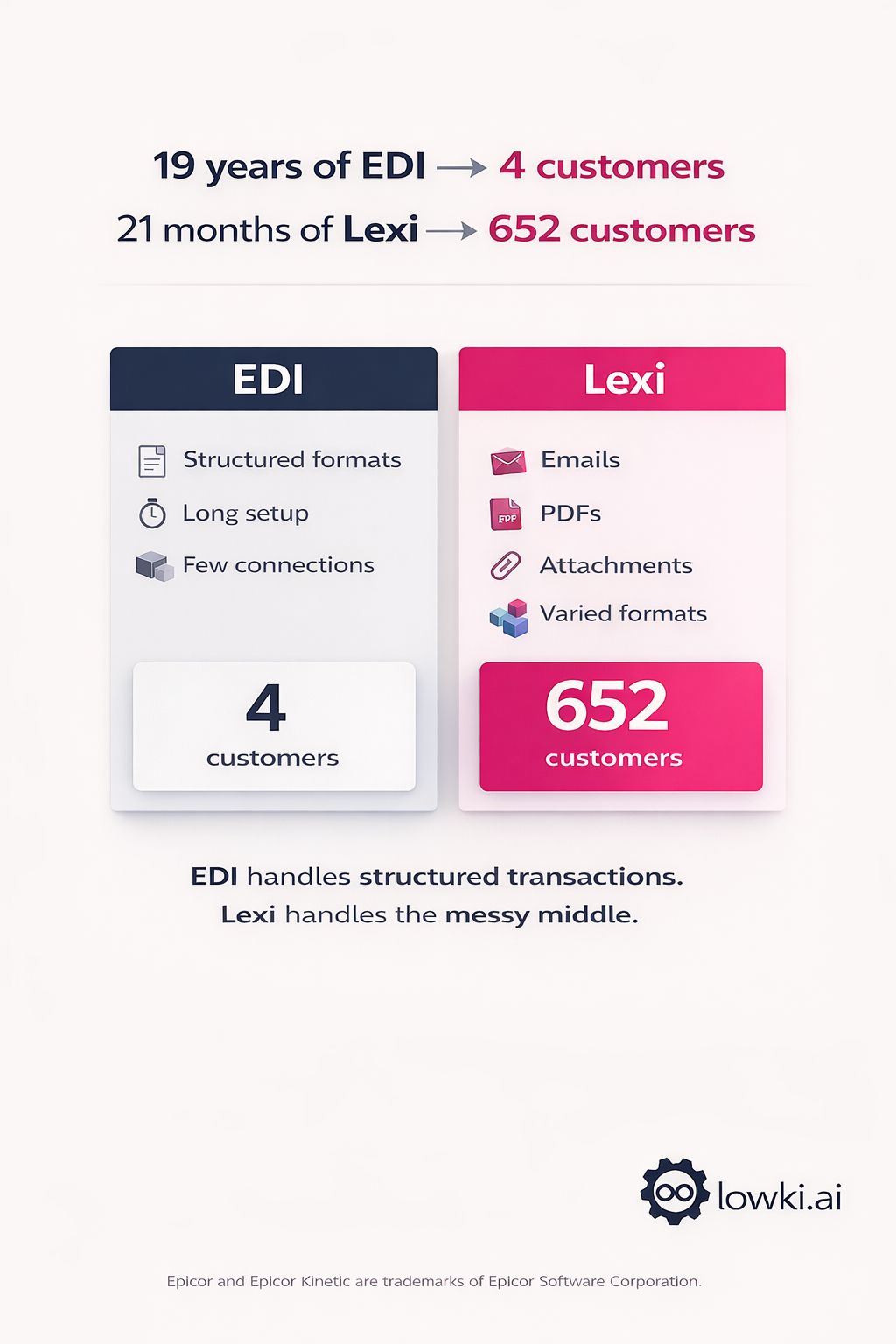
The outage made a good story, but the more important number is this one. After 19 years, EDI at Thomas Dudley Plumbing Products covers 3 customers. Lexi by lowki.ai handles orders from more than 650 of them.
That's not a criticism of EDI. It's what EDI is. It needs both sides to invest in a technical project, so it only ever reaches your biggest, most organised customers. Everyone else sends emails, PDFs and spreadsheets, in whatever layout their system happens to produce. That's the messy middle, and for most manufacturers it's most of their customers.
What I took from it
Three things.
First, plan for EDI failing. It will, eventually, and probably at a bad time. If your fallback is "people key it in", work out how many people and for how long.
Second, a document-based route is a better fallback than people, because it doesn't care whether an order arrived as EDI's backup PDF or as a customer's own email. It's the same job.
Third, the team will tell you what works. Nobody had to sell AI order entry to the sales team that month. They'd already decided it was the quicker way.
If you want to see how it handles your orders, send us a few and we'll show you.
Related: Sales order entry · Is EDI Dead? · lowki.ai vs Epicor ECM Sales Order Automation
About the author: Mark Betts
Business Technology Manager, Thomas Dudley Ltd
Mark is Business Technology Manager at Thomas Dudley, a UK manufacturing group running Epicor Kinetic, where he leads the business technology team that supports the whole group, from infrastructure and desktop support through to business systems and ERP development. He has over 20 years of commercial IT experience, all of it inside Thomas Dudley, developing and deploying business systems improvements, new routes to market and efficiency gains across the group. He works on both sides of the table: hands-on with AI, C#, SQL and Kinetic, and translating what a business needs into systems that actually deliver it. An on-prem advocate.
Mark Betts on LinkedIn