Is EDI Dead?
EDI still has its place in B2B order exchange, but after two decades it has left a structural gap between automated and manual order entry. This is where AI-driven order processing is now doing the work EDI never could.
Is EDI dead?
Not yet. But the landscape around it has changed, and a significant share of the work it was once relied on to handle is now being done by AI-driven order processing. EDI still wins where it has always won — in high-volume, structured, partner-to-partner flows. What has changed is the recognition of how narrow that territory actually is.
What EDI does well, and what it does not
When two organisations are both technically capable and willing to invest in setup, EDI is efficient. Orders arrive in a defined format, map directly into the ERP, and require no manual intervention. That is why EDI remains the backbone of structured B2B commerce between large trading partners.
The problem is that most manufacturing businesses do not live entirely in that world.
EDI is expensive to implement. Formats need to be agreed, translation layers configured, and third-party services are usually involved. Both organisations need the technical capability to support it, and it almost always requires internal IT resource to deliver and maintain. Implementation can take weeks or months. Even small changes can involve multiple parties — in-house IT, the EDI provider, and the customer's own systems — with the customer often left to coordinate between all of them.
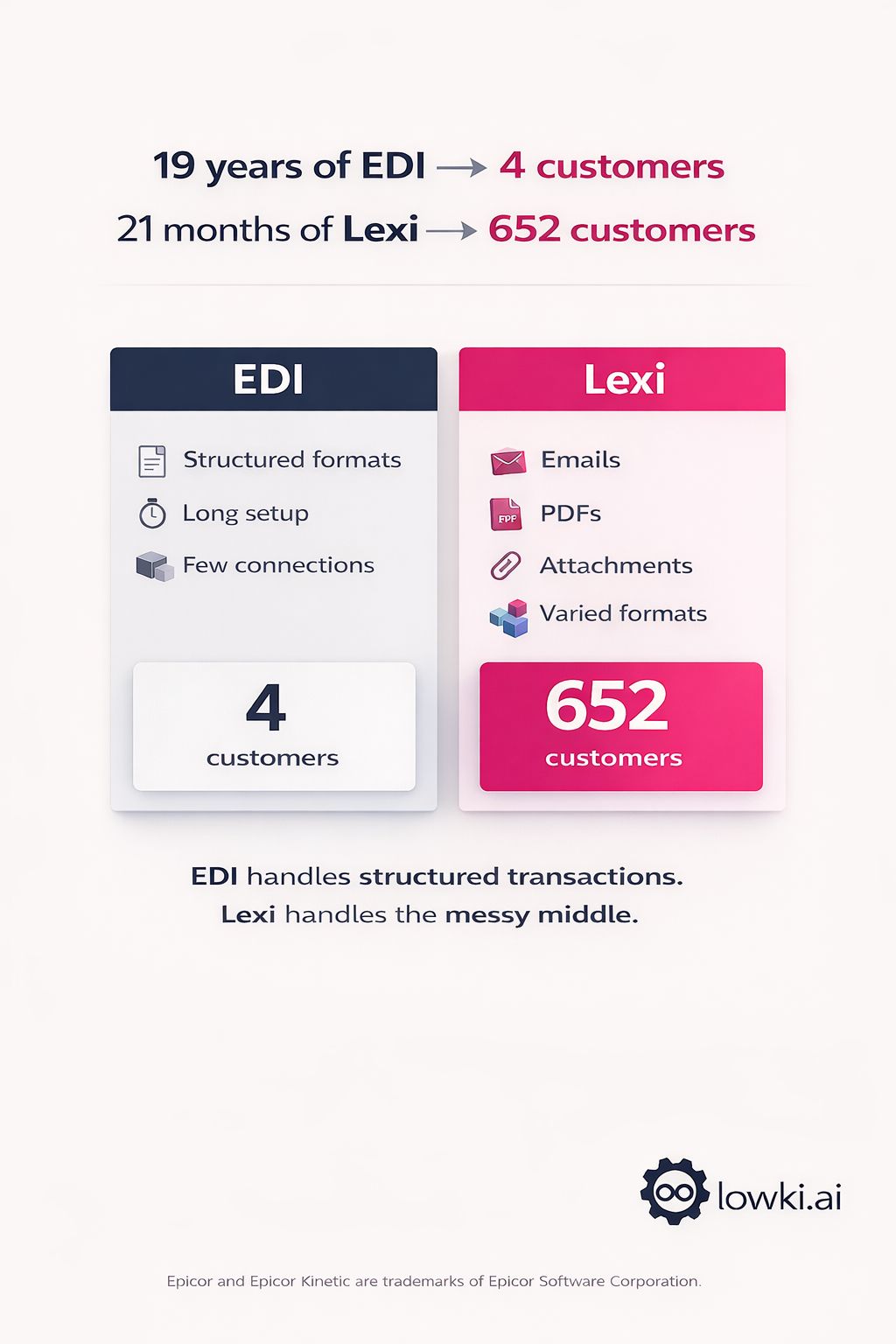
After all that effort, the typical outcome is a connection to a small number of customers. In one long-established Epicor Kinetic manufacturing environment, 19 years of EDI investment produced connections with just three customers for invoices and four for sales orders.
That is not a failure of EDI. It is a reflection of the setup cost relative to the return on any given trading partner.
The gap between EDI and manual entry
Between fully automated EDI and fully manual order entry sits the majority of the orders a manufacturer actually receives — emails, PDFs, attachments, spreadsheets, and scanned documents, each formatted differently and arriving across hundreds of customers.
Traditional automation has never solved this gap. Template-based systems require consistency that customers will not provide. OCR alone cannot interpret intent. Every new customer or format change creates fresh configuration work. And the economics only stack up at very large volumes.
This is where most of the repetitive order entry work lives, and historically it has been absorbed by people.
Where AI-driven order processing fits
Lexi was built specifically to close this gap for Epicor Kinetic manufacturers. Instead of asking customers to change how they send orders, Lexi reads the emails, PDFs, and attachments they already send and creates the order in Kinetic for review. The same approach extracts data from attachments already inside the ERP and routes it back into the right fields.
The problems this addresses are the ones that traditional automation cannot:
The varied document problem — where every customer sends orders in a slightly different layout.
The setup time issue — where automation projects take months before they deliver value.
The training burden — where staff have to learn yet another system.
The cost problem — where automation only makes sense at very high volumes.
The maintenance problem — where traditional document systems require continual reconfiguration for every new format.
In 20 months of production at a UK manufacturing operation, Lexi has processed orders from more than 650 customers. The same pattern is now appearing in other Epicor Kinetic environments as Lexi rolls out commercially.
EDI is not dead — but it was never meant to cover this ground
EDI still has its place, particularly for large structured transaction flows between trading partners with shared infrastructure. That will not change.
What has changed is the availability of a second layer of automation that handles everything EDI was never designed for. For most manufacturers, the practical question is no longer EDI versus manual entry. It is how much of the middle ground — the repetitive work that lives between the two — can now be automated at a fraction of the cost and setup time of EDI.
For most operations, the answer is: most of it.