How PECO Enters Sales Orders into Kinetic with lowki.ai
A family manufacturer in Devon uses Lexi by lowki.ai to take the typing out of part of its sales order entry in Epicor Kinetic. Here is how it works day to day, in the words of the people who use it.
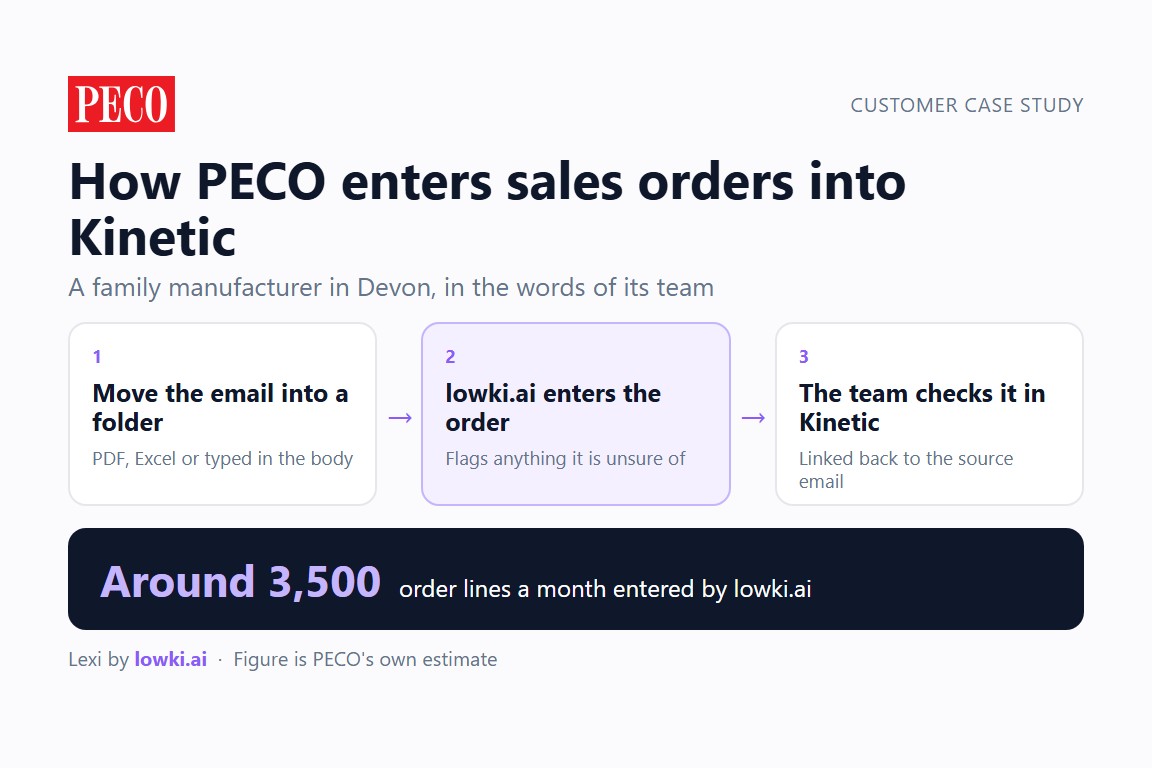
Pritchard Patent Product Co. (PECO) is a family business in Seaton, Devon, founded in 1946 and known for its model railway products. It has run Lexi by lowki.ai on Epicor Kinetic since February 2026, and lowki.ai now enters around 3,500 of its order lines a month.
This is the story of how that works, mostly in the words of Kat Mitchell, ERP Development Manager, and Mark Peake, Sales Advisor in Trade Sales. It comes from a recorded feedback session on 21 September 2026, plus figures Kat confirmed by email on 2 November 2026. The numbers are PECO's own estimates, so we have kept the "around".
Three ways in, none of them quick
PECO's orders arrive in three forms: typed into the body of an email, attached as a PDF, or sent as an Excel file. The first two were entered by hand, line by line. The Excel files were cut and pasted.
When PECO first went live on Kinetic, before lowki.ai, a 300-line order took the team around three and a half to four hours to type in.
We created a spreadsheet for customers to fill in so that we could then copy and paste, but sometimes even using that was quite long winded.
Kat Mitchell, ERP Development Manager
PECO hadn't looked at EDI or other automation tools before lowki.ai. The spreadsheet templates helped a little, but adoption was inconsistent and the manual entry remained. In busy periods the team was also pulling in help from finance just to keep on top of order volume.
Live in days, with no integration project
Mark Betts, founder of lowki.ai, spent two days on site: one on the technical deployment and one working directly with the sales team. Kat's summary of the back-end work:
I think the back end side of it was probably less than a day's worth of work to get us going… it didn't affect IT massively.
Kat Mitchell, ERP Development Manager
There was no integration project to plan around. PECO went live in a matter of days.
Drop the email in a folder and carry on
Day to day, the team moves each order email, with its PDF or Excel attachment, into a designated folder in their email client. Several can go in at once. lowki.ai enters each order into Kinetic as a sales order and flags anything it's unsure of, while the team gets on with other work. They check what it has entered afterwards.
You could drop [a big order] in the folder, and whilst it's doing that, you could be actually looking at the back orders to get that ready to put together. So it just allows you to crack on and do other elements without just waiting for one to be done.
Mark Peake, Sales Advisor, Trade Sales
Every order in Kinetic links back to the original email and attachments, so there is always something to check against.
When we're doing a copy and paste, obviously we don't then have the order attached to the sales order. Whereas obviously when we use [lowki.ai], we have that in the system.
Mark Peake, Sales Advisor, Trade Sales
What changed
lowki.ai enters around 3,500 of PECO's order lines a month, and the team checks each order it enters. In their own words, here is what they noticed.
Several orders at once. Five big orders can go into the folder together while the team gets on with back orders.
The fact that I could drag in, say, five big orders into the folder at any one time… let it do its thing whilst I can then do other elements at the same time. That is good. That's a big time saver and a bit of a game changer on how we used to work before.
Mark Peake, Sales Advisor, Trade Sales
Messy emails, often read correctly. Quantities, part numbers and reference numbers jumbled together in an email body, including a purchase order reference picked out of a messy block of text.
I've often thought, I'll be honest with you, [lowki.ai] is not going to cope with this one, but often it has. So it's proved me wrong one or two times.
Mark Peake, Sales Advisor, Trade Sales
A new trade portal, tested first. PECO tested with the portal's CSV and PDF orders before launch, and added ship-to details to the portal's PDF output. Two attachments on one email no longer cause a problem.
Order entry at head office. Sales reps used to enter their own orders. Head office now does, which gives reps more time on the road and with customers.
Our sales reps used to put on their own orders but our head office now put them on… That's a huge amount of savings [in time] and gives our sales reps more time on the road and talking to our customers.
Kat Mitchell, ERP Development Manager
Very little IT upkeep. There is nothing for PECO's IT department to look after, and there was very little work to integrate it in the first place.
There's not really anything that our IT department have to do for [lowki.ai]. So I think that's another bonus as well… we didn't have a huge amount to do with the integrating or the upkeep of [it]. It's been very minimal. And I think that's a really good thing for potential customers.
Kat Mitchell, ERP Development Manager
An assistant, not a replacement
Order entry that used to need help from finance in busy periods no longer does.
The finance team were already trying to fit order entry around their existing workload, with very little spare capacity. AI has not replaced staff; it has enabled us to achieve more with the people we have.
Kat Mitchell and Mark Peake
It's an assistant. It's a tool to help you do your job. It's not doing it 100% at all… it's an aid to do your job more efficiently.
Mark Peake, Sales Advisor, Trade Sales
Where it still needs a person
PECO was candid about the limits:
- It can't tell trade packs from single-unit quantities when a customer's order format doesn't make that clear, so the team checks quantities on the sales order in Kinetic.
- It couldn't process one customer's Excel order, created in software PECO hadn't come across before. The exact cause wasn't identified.
- Other recognition errors are rare and are treated as routine tuning. PECO has improved recognition by adding cross-reference numbers for part numbers that customers enter in outdated formats.
PECO's team also looks over each order before it goes for picking, and wants it that way.
You would always want that element of just having a quick scan down through, making sure it's all correct, because also your customers aren't always going to get it right… you want to make sure that you're giving your customers the best customer service you can.
Kat Mitchell, ERP Development Manager
We recommend the same approach to every customer: a hold in your own Kinetic work process so every order is reviewed first. lowki.ai works with your process and doesn't change it.
Would they recommend it?
Absolutely. I would highly recommend it to other businesses.
Kat Mitchell, ERP Development Manager
From my own experiences, then yes, very much so. For that sheer time-saving convenience and reliability.
Mark Peake, Sales Advisor, Trade Sales
If you'd like to see what lowki.ai reads from your own orders, send us a few and we'll show you the extracted data, then walk you through the full flow into Kinetic in a live demo.
Related: The full PECO case study · Sales order entry · Built on Kinetic, not beside it
About the author: Mark Betts
Business Technology Manager, Thomas Dudley Ltd
Mark is Business Technology Manager at Thomas Dudley, a UK manufacturing group running Epicor Kinetic, where he leads the business technology team that supports the whole group, from infrastructure and desktop support through to business systems and ERP development. He has over 20 years of commercial IT experience, all of it inside Thomas Dudley, developing and deploying business systems improvements, new routes to market and efficiency gains across the group. He works on both sides of the table: hands-on with AI, C#, SQL and Kinetic, and translating what a business needs into systems that actually deliver it. An on-prem advocate.
Mark Betts on LinkedIn