Why Lexi Deploys in Hours, Not Months
Most ERP projects take months. Lexi was designed specifically to avoid that. Here's how a product shaped inside a live manufacturing operation ended up deploying in hours rather than weeks.
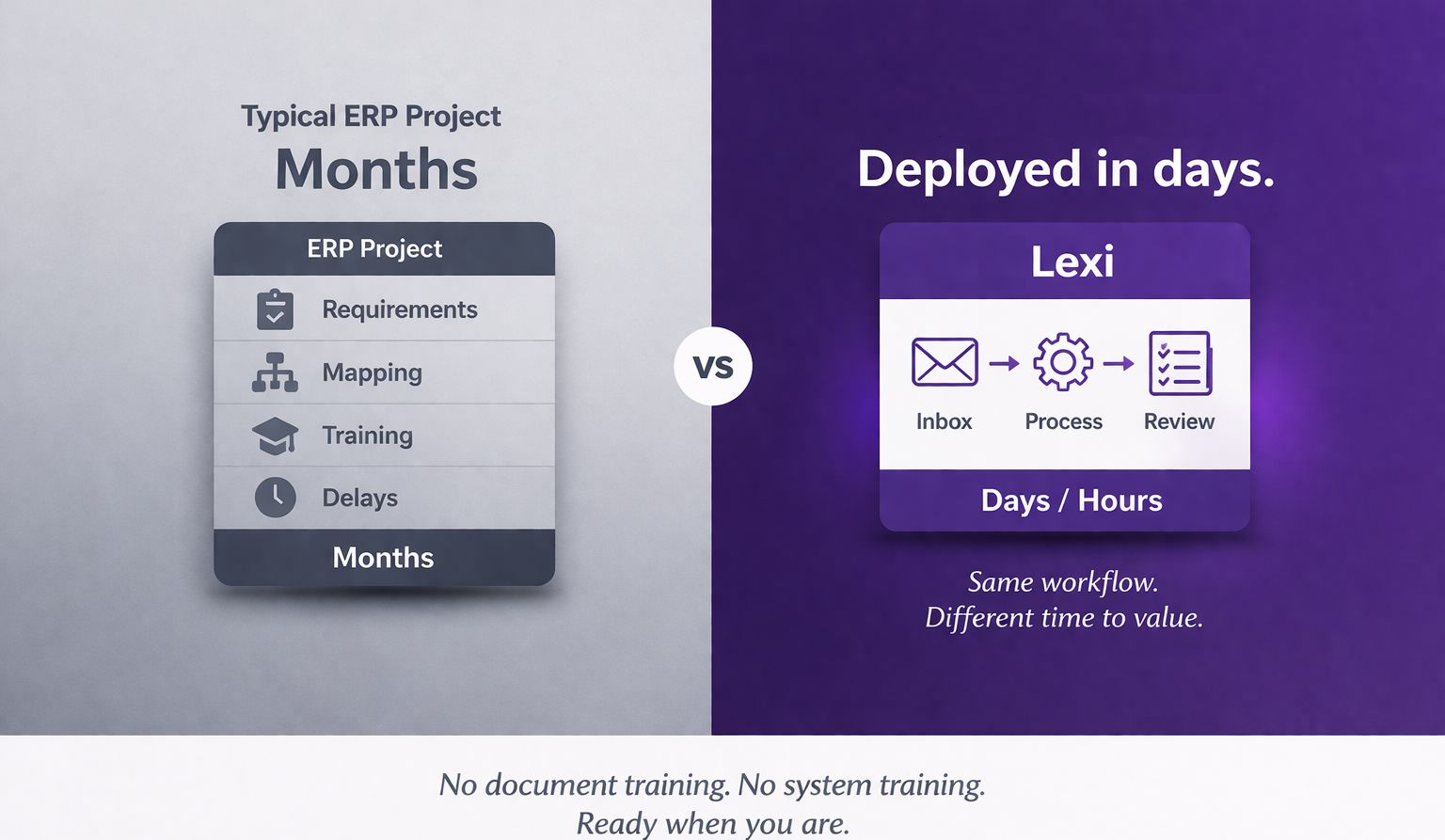
Most ERP projects take months. Lexi did and did not.
The product itself took several months to reach its current state, but not in the way ERP projects usually consume time. Very little of that was traditional development work. Most of it was spent shaping the product around how orders are actually processed inside a live manufacturing business.
The result is that when Lexi reaches a new site, it does not arrive as a project to be managed. At the first external deployment, integration with the sales team took a matter of days. Across subsequent deployments, rollout has been measured in hours.
That is not how these projects normally go.
Built inside the business, not the demo
Most order automation products are built by software companies. They are designed in isolation from the environment they are meant to serve, then shipped to a customer who has to absorb the cost of making them fit.
Lexi was built the other way round. It was developed inside a manufacturing business with a live sales team, a live ERP, and live order volume. That environment provided something a software company cannot replicate: a constant stream of real-world edge cases, generated by a real customer base, against a real catalogue.
The first version was deliberately simple. It read documents from a folder on a desktop. From there it evolved into something that works directly with email, attachments, and the way the team already operates.
Feedback was central to this. Issues were captured using tally sheets on desks rather than spreadsheets, so they could be logged in the moment rather than written up later. That produced an honest record of where the product worked, where it did not, and what mattered most to the people using it.
By the time Lexi was ready to deploy externally, it was not a concept or a prototype. It was a product that had already been shaped around real sales order entry.
What makes deployment different
Traditional automation projects involve agreeing formats, mapping documents, training the system, training the team, and then waiting for the combination to settle down. Each of those steps consumes time, resource, and goodwill.
Lexi was designed to avoid all of them.
There is no document training and no need to set customers up individually. The team does not have to learn a new system. Orders still come in as emails, PDFs, and attachments, exactly as they always have. They are simply moved into the process, Lexi reads them, and the order is created in Epicor Kinetic for review.
The team still checks every order, and anything unusual is flagged. But the system starts being useful immediately rather than after a settling-in period.
The real difference
The point is not that Lexi can do the job. Plenty of tools can do parts of the job given enough setup time and configuration.
The difference is how quickly it becomes part of the day-to-day operation. When automation takes months to deliver value, adoption suffers, momentum stalls, and the business case erodes before the tool has had a chance to prove itself.
When it takes hours, the business sees the return inside the same week it starts using the product. That is the practical definition of turnkey, and it is the reason Lexi deploys the way it does.